Home · Catalogue · Architecture, Art & Craft · S.I.3456
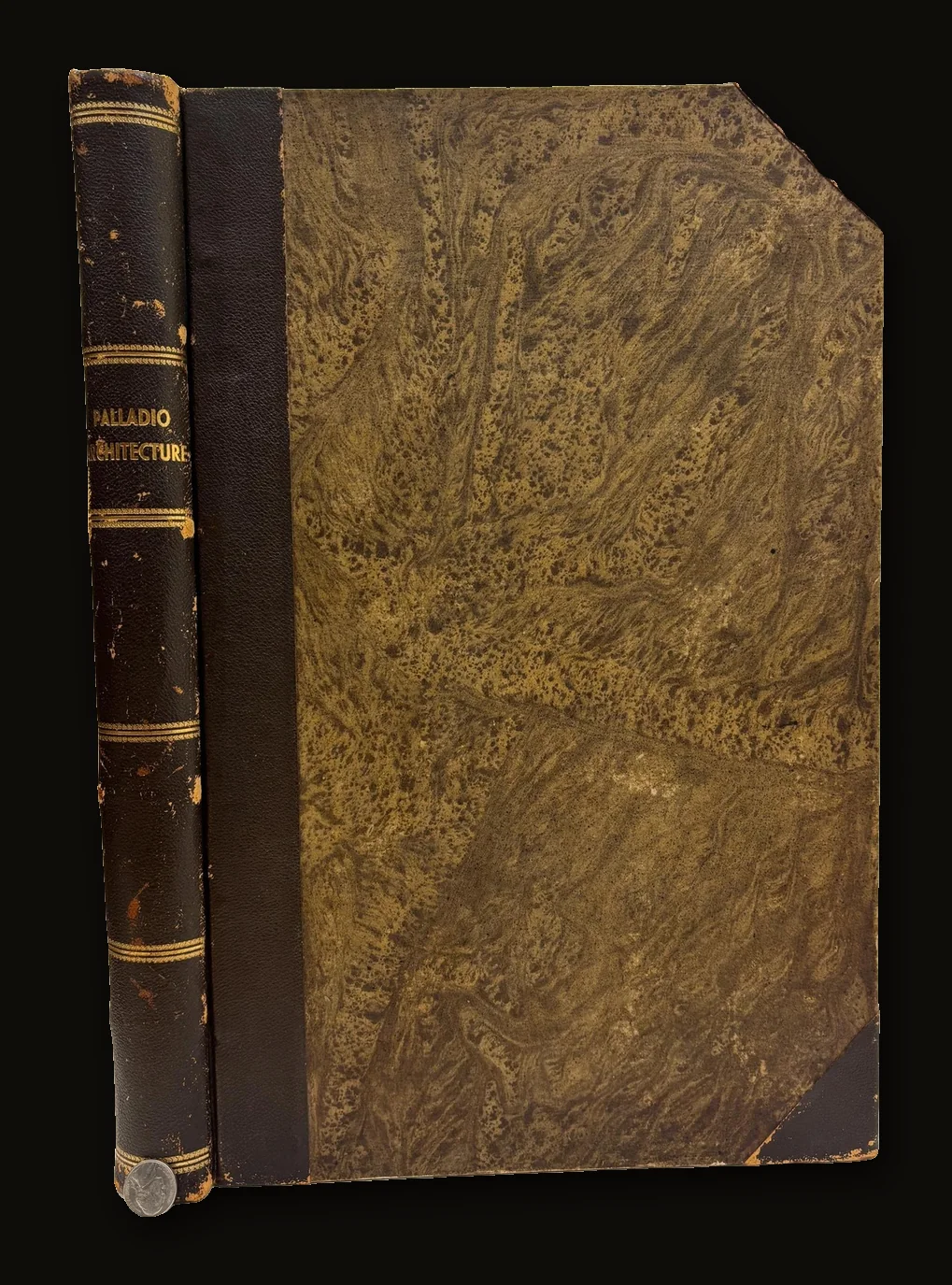
Architecture De Palladio, Divisée En Quatre Livres: Dans Lesquels, Après un Traité des cinq Ordres, joint aux observations les plus nécessaires pour bien bâtir, Il Est Parlé De la Construction des Maisons publiques & particuliéres des grands-chemins, des ponts, des places-publiques, des xystes, & des temples; avec leurs plans, profils, coupes, & elevations Avec Des Notes D'Inigo Jones, qui n'avoient point encore été imprimées. Le tout revu, dessiné, & nouvellement mis au jour Par Jaques Leoni, Venitien, Architecte de S.A.S. l'Electeur Palatin. Traduit De L'Italien Tome Premier Contenant les deux premiers Livres. GOOGLE TRANSLATION: Architecture Of Palladio, Divided Into Four Books: In Which, After A Treatise Of The Five Orders, Attached To The Observations Most Necessary To Build Well, It Is Speaking Of The Construction Of Public Houses & Particulars Of Highways, Bridges, Squares -publics, xysts, & temples; with their plans, profiles, sections, & elevations With Notes Of Inigo Jones, which had not yet been printed. All reviewed, drawn, & newly updated By Jaques Leoni, Venitian, Architect of H.S.H the Elector Palatine. Translated From Italian Tome Premier Containing the First Two Books. Google Translation: Architecture Of Palladio, Divided Into Four Books: In Which, After A Treatise Of The Five Orders, Attached To The Observations Most Necessary To Build Well, It Is Speaking Of The Construction Of Public Houses & Particulars Of Highways, Bridges, Squares -publics, xysts, & temples; with their plans, profiles, sections, & elevations. With Notes Of Inigo Jones, which had not yet been printed. All reviewed, drawn, & newly updated By Jaques Leoni, Venitian, Architect of H.S.H the Elector Palatine. Translated From Italian Tome Premier, Containing the First Two Books.
Palladio, Andrea / Inigo Jones / Jaques Leoni · La Hage (The Haag)
- Author
- Palladio, Andrea / Inigo Jones / Jaques Leoni
- Date
- 1726
- Place
- La Hage (The Haag)
- Publisher
- Pierre Goose
- Language
- English
- Binding
- Folio, (17-1/4" x 11-1/2" x 1-1/4"). 3/4 period brown calf & marbled boards. Books First and Second only.
- Format
- Andrea Palladio (/pəˈlɑːdioʊ/ pə-LAH-dee-oh; Italian: [anˈdrɛːa palˈlaːdjo]; 30 November 1508 – 19 August 1580) was an Italian Renaissance architect active in the Venetian Republic. Palladio, influenced by Roman and Greek architecture, primarily Vitruvius, is widely considered to be one of the most influential individuals in the history of architecture. While he designed churches and palaces, he was best known for country houses and villas. His teachings, summarized in the architectural treatise, The Four Books of Architecture, gained him wide recognition. The city of Vicenza, with its 23 buildings designed by Palladio, and 24 Palladian villas of the Veneto are listed by UNESCO as part of a World Heritage Site named City of Vicenza and the Palladian Villas of the Veneto. The churches of Palladio are to be found within the "Venice and its Lagoon" UNESCO World Heritage Site. Palladio was born on 30 November 1508 in Padua and was given the name Andrea di Pietro della Gondola. His father, Pietro, called "della Gondola", was a miller. From an early age, Andrea Palladio was introduced into the work of building. When he was thirteen, his father arranged for him to be an apprentice stonecutter for a period of six years in the workshop of Bartolomeo Cavazza da Sossano, a noted sculptor, whose projects included the altar in the Church of Santa Maria dei Carmini in Padua. Bartolomeo Cavazza is said to have imposed particularly hard working conditions: Palladio fled the workshop in April 1523 and went to Vicenza, but was forced to return to fulfil his contract. In 1524, when his contract was finished, he moved permanently to Vicenza, where he resided for most of his life. He became an assistant to a prominent stonecutter and stonemason, Giovanni di Giacomo da Porlezza in Pedemuro San Biagio, where he joined the guild of stonemasons and bricklayers. He was employed as a stonemason to make monuments and decorative sculptures. His career was unexceptional until 1538–39; when he had reached the age of thirty, he was employed by the humanist poet and scholar Gian Giorgio Trissino to rebuild his residence, the Villa Trissino at Cricoli. Trissino was deeply engaged in the study of ancient Roman architecture, particularly the work of Vitruvius, which had become available in print in 1486. In 1540, Palladio finally received the formal title of architect. In 1541, he made a first trip to Rome, accompanied by Trissino, to see the classical monuments first-hand. He took another, longer trip to Rome with Trissino from the autumn of 1545 to the first months of 1546, and then another trip in 1546–1547. He also visited and studied the Roman works in Tivoli, Palestrina and Albano. Trissino exposed Palladio to the history and arts of Rome, which gave him inspiration for his future buildings. In 1554 he would publish guides to the city's ancient monuments and churches. Trissino also gave him the name by which he became known, Palladio, an allusion to the Greek goddess of wisdom Pallas Athene and to a character in a play by Trissino. The word Palladio means Wise one. The success of the Basilica Palladiana propelled Palladio into the top ranks of the architects of Northern Italy. He had travelled to Rome in 1549, hoping to become a Papal architect, but the death of Pope Paul III ended that ambition. His patron, Gian Giorgio Trissino, died in 1550, but in the same year Palladio gained new supporter, the powerful Venetian aristocrat Daniele Barbaro. Through Barbaro he became known to the major aristocratic families of Northern Italy. In addition to the Barbaros, the aristocratic Cornaro, Foscari, and Pisani families supported Palladio's career, while he continued to construct a series of magnificent villas and palaces in Vicenza in his new classical style, including the Palazzo Chiericati in Vicenza, the Villa Pisani in Montagnana, and the Villa Cornaro in Piombino Dese. Cardinal Barbaro brought Palladio to Rome and encouraged him to publish his studies of classical architecture. In 1554, he published the first of a series of books, Antiquities of Rome. He continued to compile and write his architectural studies, lavishly illustrated, which were published in full form in 1570 as I quattro libri dell'architettura (The Four Books of Architecture), in Venice. These books, reprinted in different languages and circulated widely in Europe, secured his reputation as the most influential figure in the renewal classical architecture, a reputation which only continued to grow after his death.
- Category
- Architecture, Art & Craft
- Record
- S.I.3456
Architecture De Palladio, Divisée En Quatre Livres: Dans Lesquels, Après un Traité des cinq Ordres, joint aux observations les plus nécessaires pour bien bâtir, Il Est Parlé De la Construction des Maisons publiques & particuliéres des grands-chemins, des ponts, des places-publiques, des xystes, & des temples; avec leurs plans, profils, coupes, & elevations Avec Des Notes D'Inigo Jones, qui n'avoient point encore été imprimées. Le tout revu, dessiné, & nouvellement mis au jour Par Jaques Leoni, Venitien, Architecte de S.A.S. l'Electeur Palatin. Traduit De L'Italien Tome Premier Contenant les deux premiers Livres. GOOGLE TRANSLATION: Architecture Of Palladio, Divided Into Four Books: In Which, After A Treatise Of The Five Orders, Attached To The Observations Most Necessary To Build Well, It Is Speaking Of The Construction Of Public Houses & Particulars Of Highways, Bridges, Squares -publics, xysts, & temples; with their plans, profiles, sections, & elevations With Notes Of Inigo Jones, which had not yet been printed. All reviewed, drawn, & newly updated By Jaques Leoni, Venetian, Architect of H.S.H the Elector Palatine. Translated From Italian Tome Premier Containing the First Two Books. 1726. La Hage (The Haag): Pierre Goose.
Folio, (17-1/4" x 11-1/2" x 1-1/4"). 3/4 period brown calf & marbled boards. Books First and Second only. Andrea Palladio (/pəˈlɑːdioʊ/ pə-LAH-dee-oh; Italian: [anˈdrɛːa palˈlaːdjo]; 30 November 1508 – 19 August 1580) was an Italian Renaissance architect active in the Venetian Republic. Palladio, influenced by Roman and Greek architecture, primarily Vitruvius, is widely considered to be one of the most influential individuals in the history of architecture. While he designed churches and palaces, he was best known for country houses and villas. His teachings, summarized in the architectural treatise, The Four Books of Architecture, gained him wide recognition.
Free shipping via USPS for United States purchasers within the continental U.S., International shipping determined using USPS Priority Express, DHL, FedEx, or Parcel Monkey. We are currently putting all 5000+ titles online, but if there is a specific title you are looking for, please reach out, we may just have it! Sonny Ideker Bookseller is located within City Antiques in Historic Roswell, Georgia, at 700 Holcomb Bridge Road, Roswell, GA. 30076. We look forward to your visit or to hearing from you via email with any specific requests or needs. Thanks!
Antique Books, Old Leather Book, Old Vellum Book, Decorative Binding, Antiquarian Book, Vintage decorative, Ancient Leather, Rare Books, Decorative Books, Decorative Leather, Beautiful Decorative Book, That Rare Book Guy, Sonny Ideker, City Antiques & Interior Arts, Georgia Antiquarian Booksellers Association.
Condition
Condition report available on request — ask and we will send a written report with additional photographs.
Guaranteed authentic and as described · 7-day returns · free US shipping — our terms. Subject to prior sale.