Home · Catalogue · Science & Medicine · S.I.7370
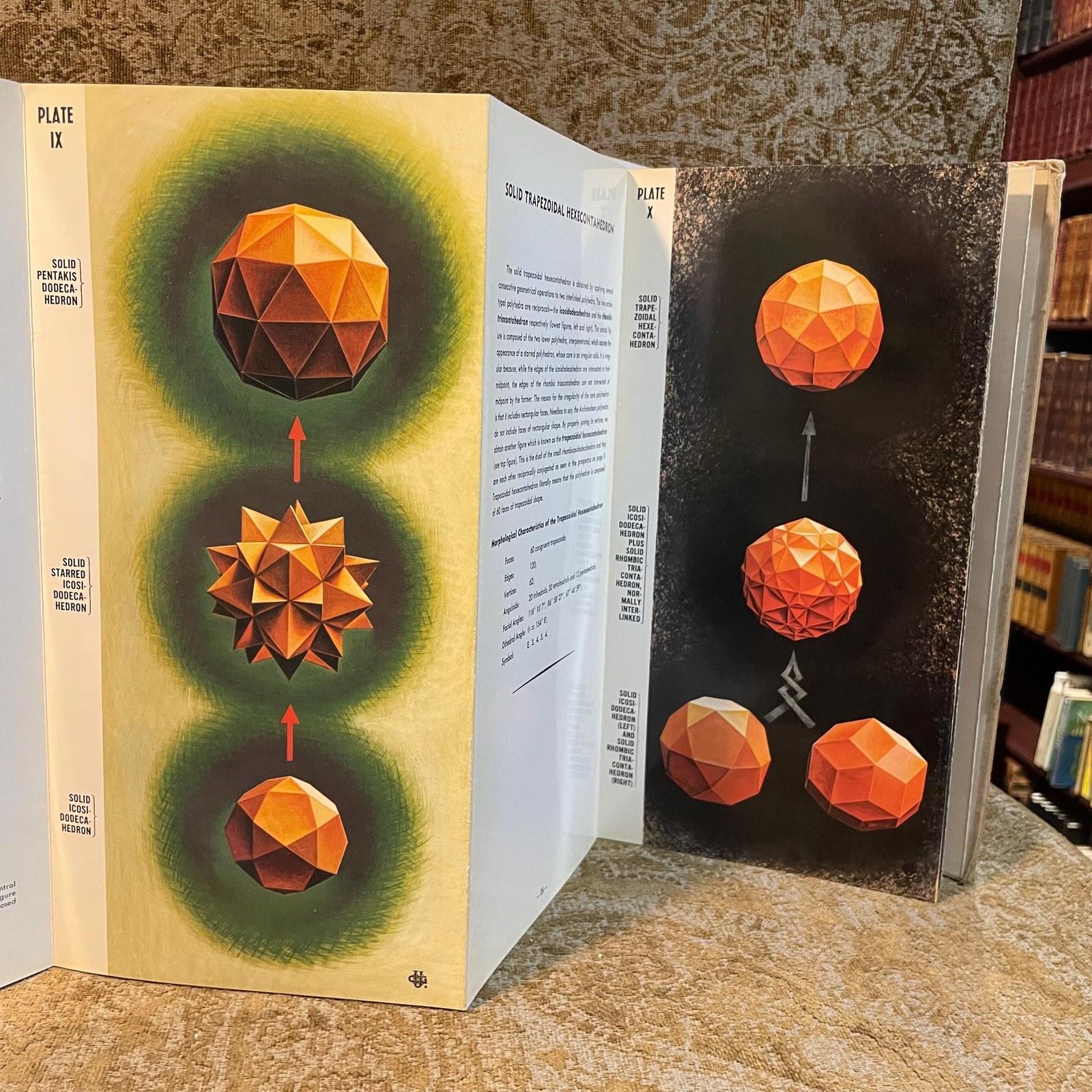
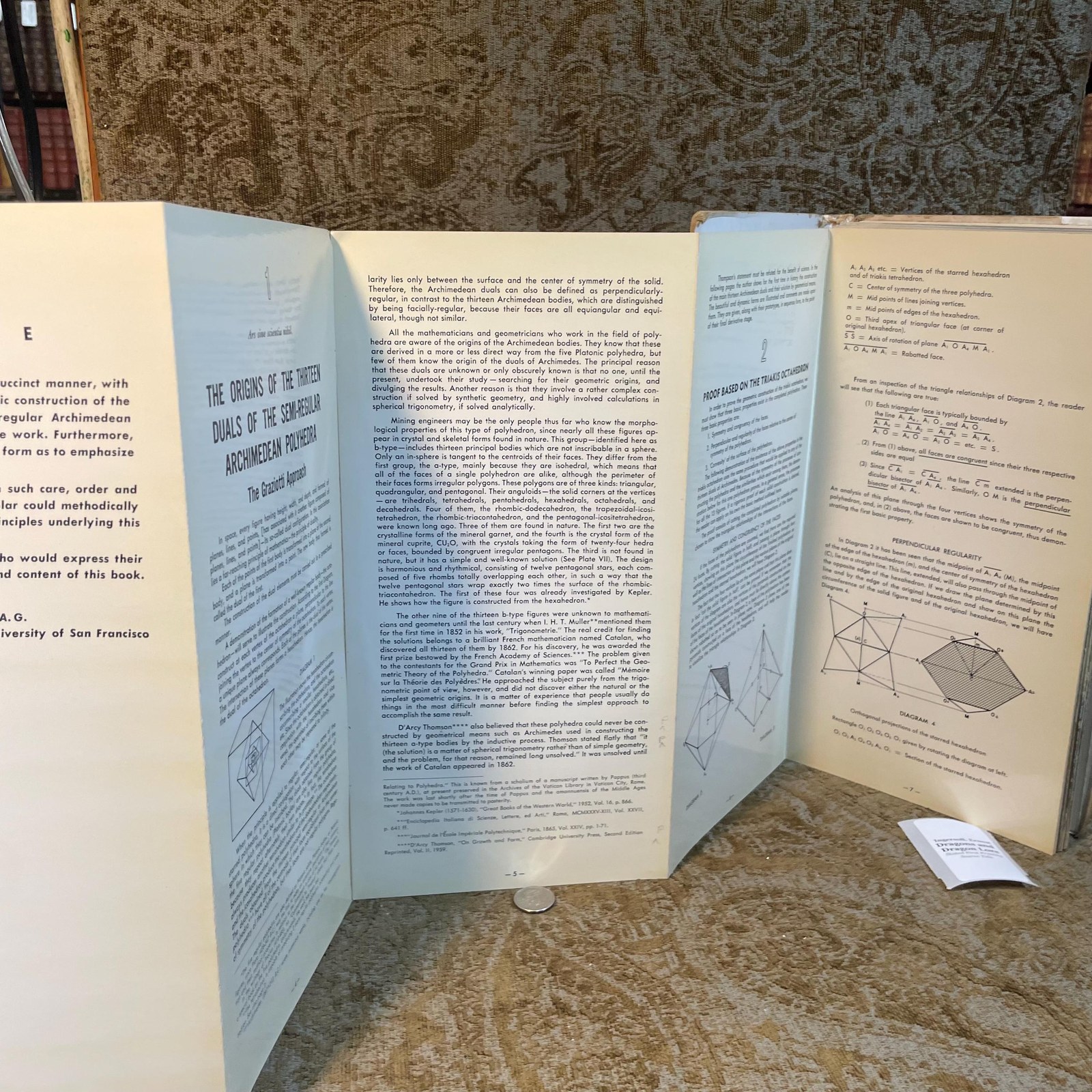
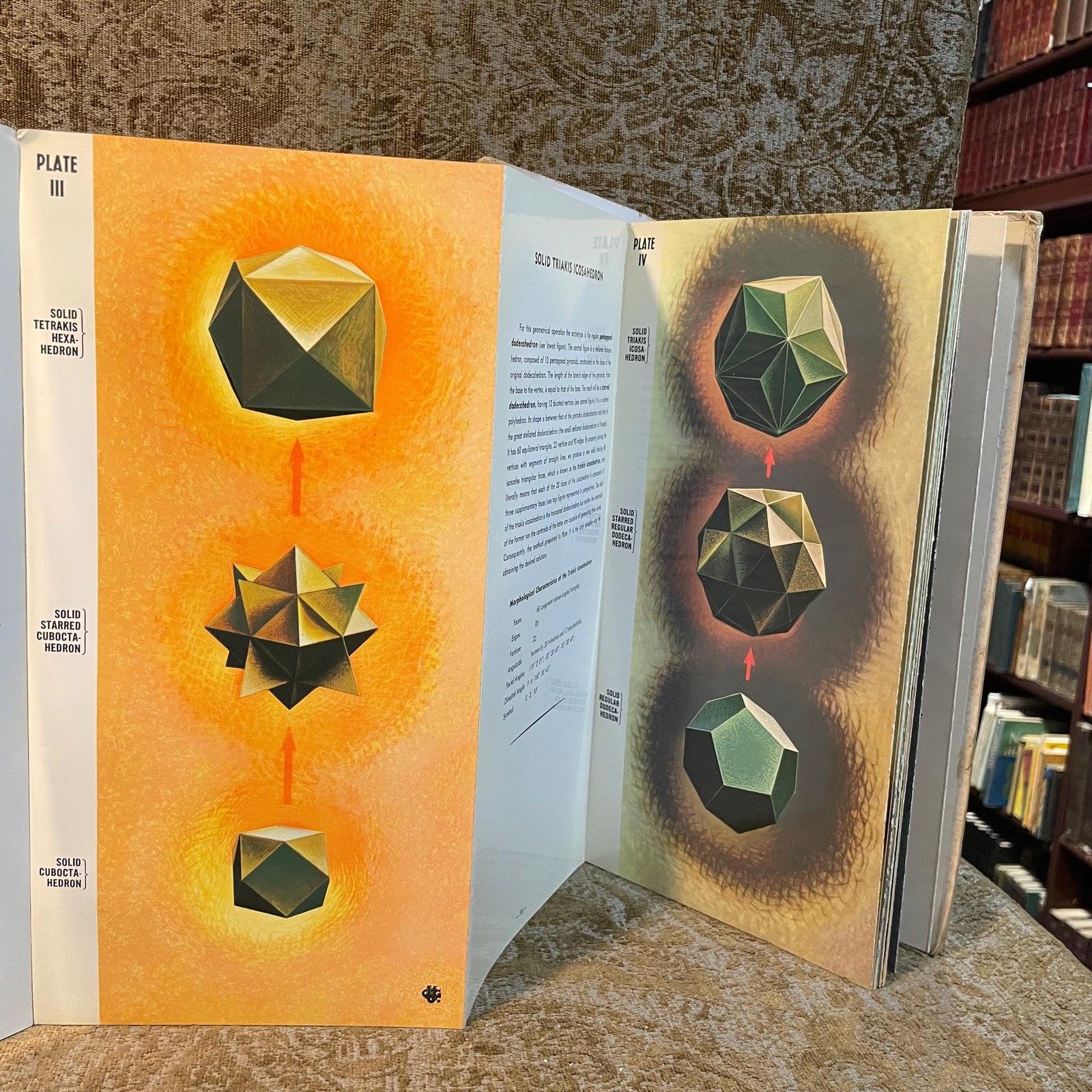
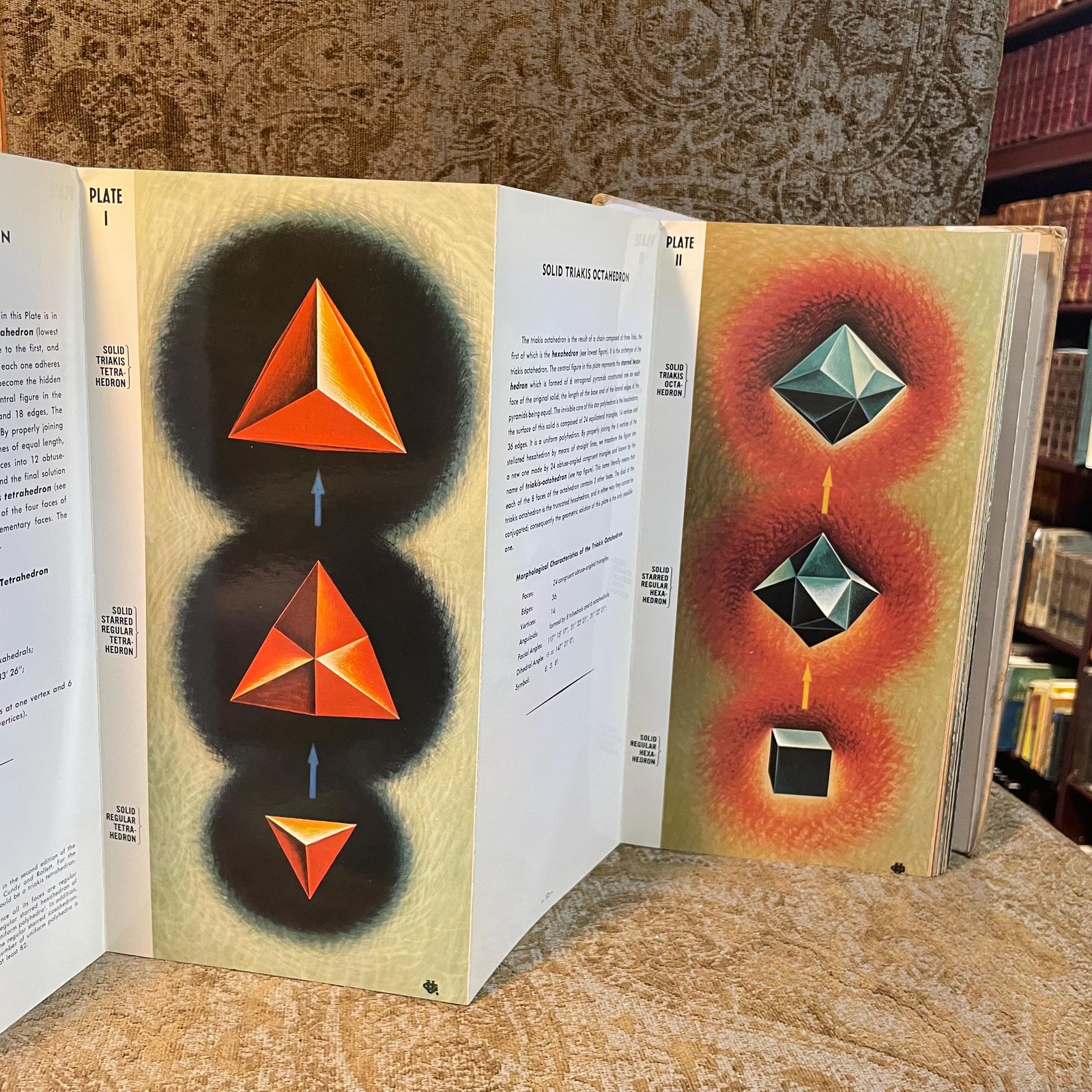
Polyhedra. The Realm of Geometric Beauty
Graziotti, Ugo Adriano · San Francisco
- Author
- Graziotti, Ugo Adriano
- Date
- 1962
- Place
- San Francisco
- Publisher
- Ugo Adriano Graziotti
- Language
- English
- Binding
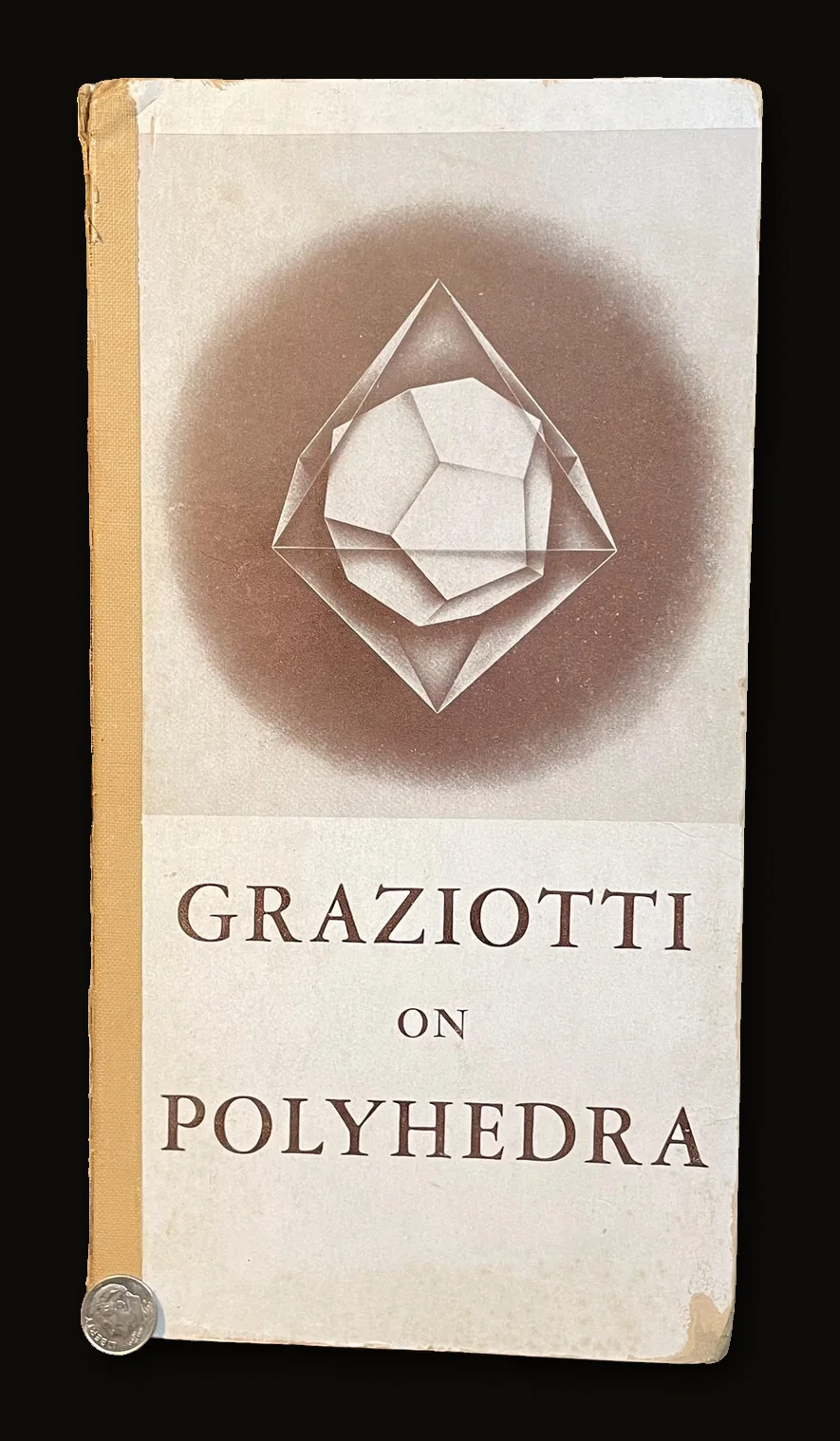
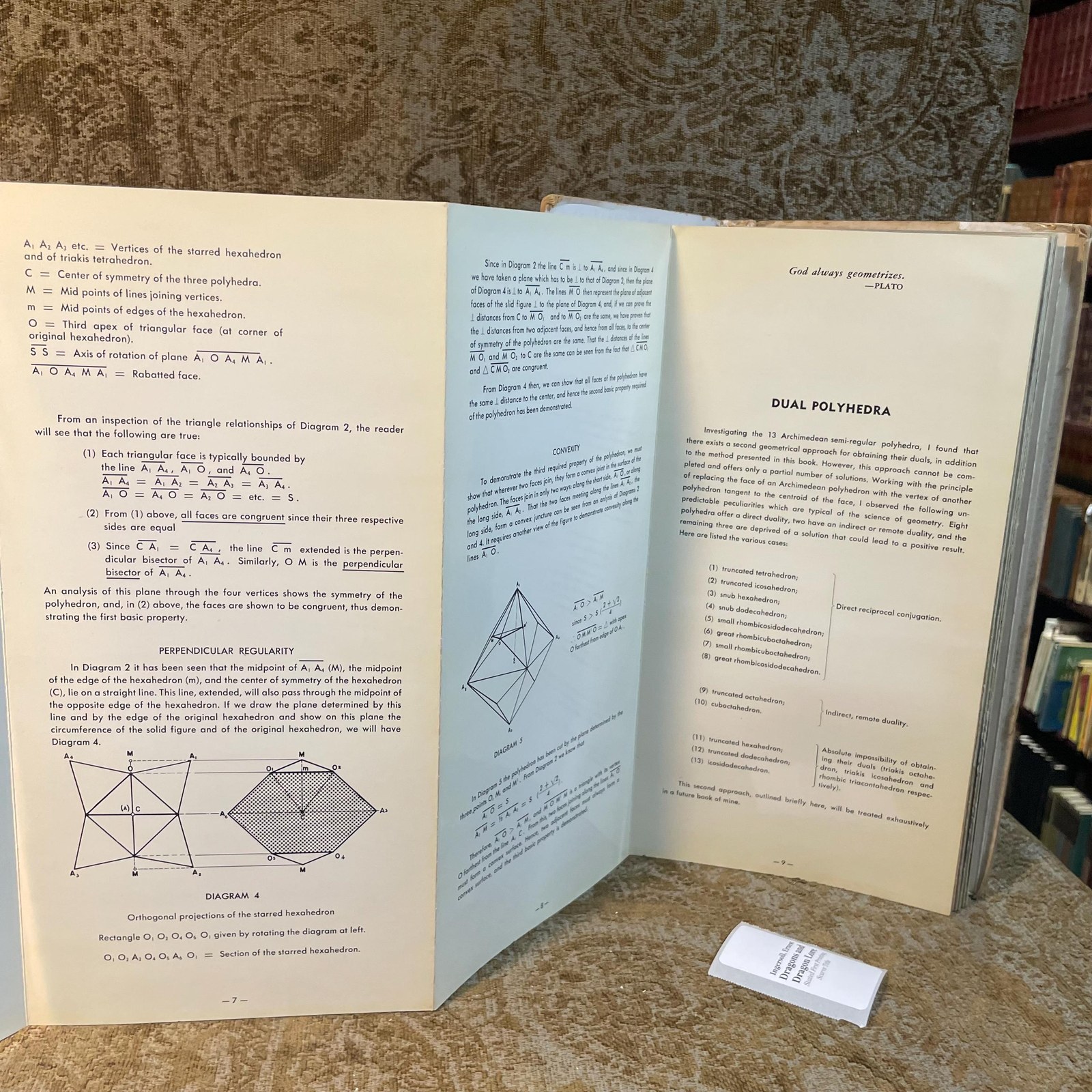
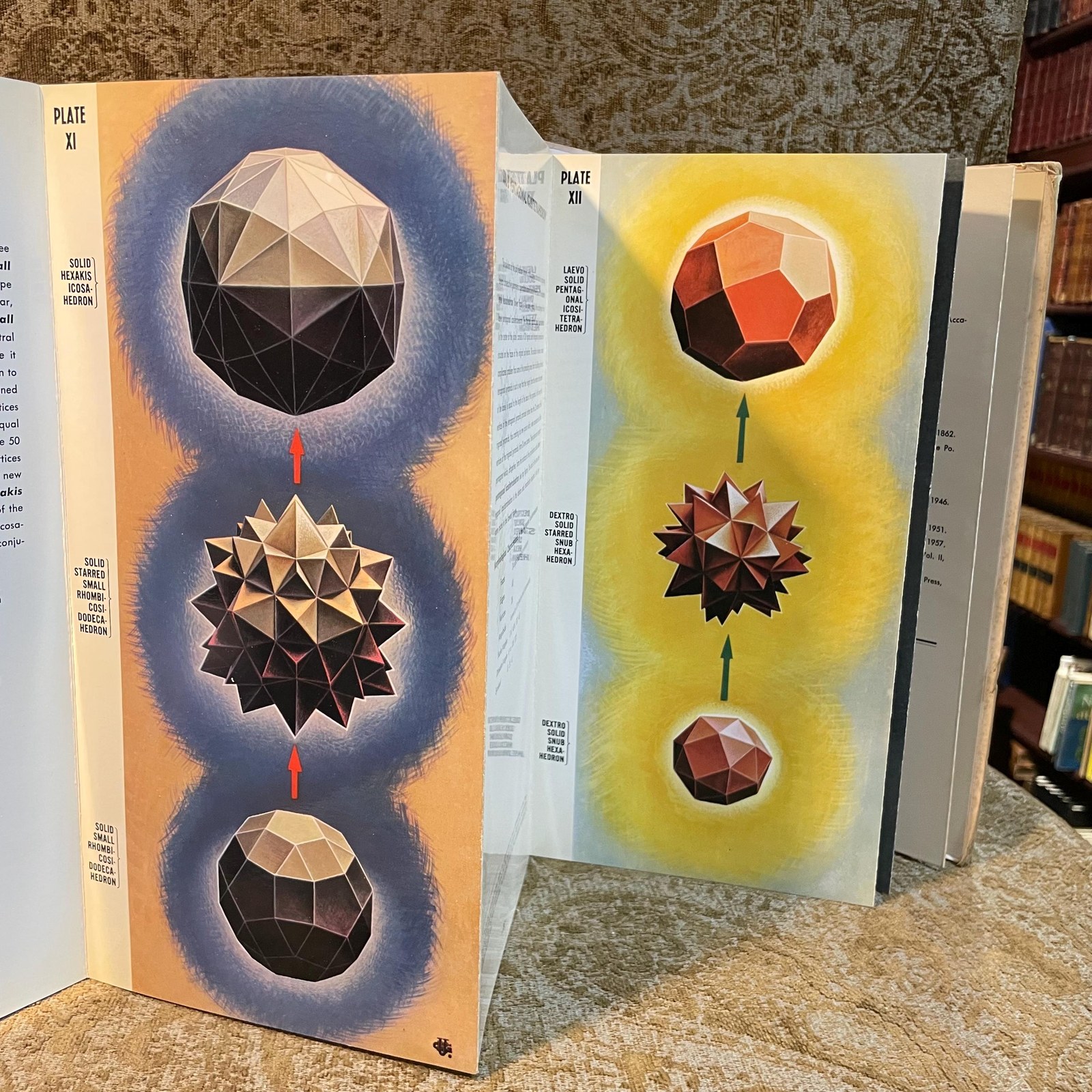
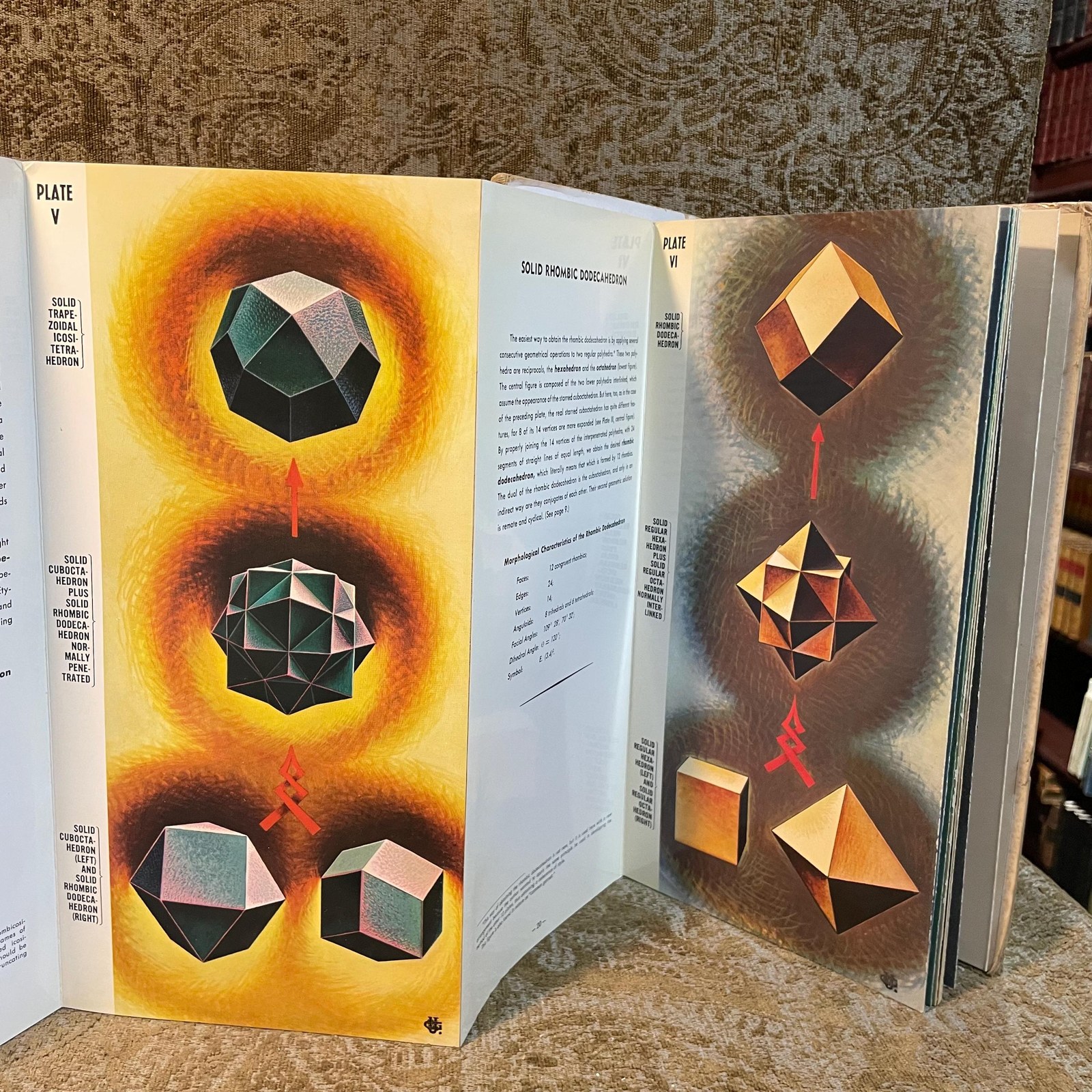
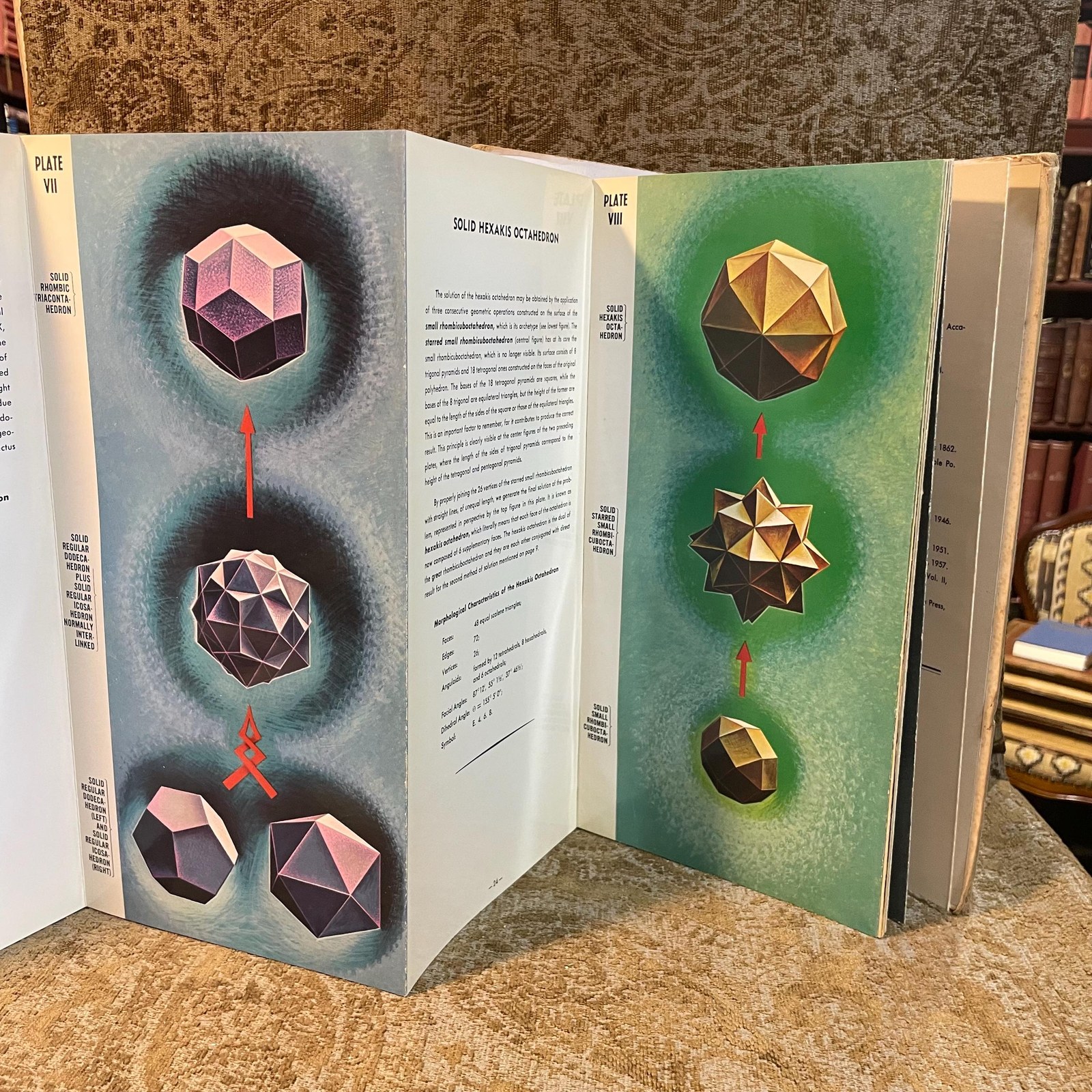
- 4to. (5.5" x 11") Limited Edition, author signed. Tall quarto with 38 glossy accordion folding pages. Printed upper board of polyhedra decoration with printed author/title, rear blank. Tan tape spine. Author autographed to attestation page, #00938/1000. Edgewear, corners bumped and rubbed with small loss to tips, head and foot of spine frayed with small loss, upper front hinge with 2" tear, covers lightly soiled (see pic). An interesting, scarce title for a mathematician, or anyone who likes shapes.
- Format
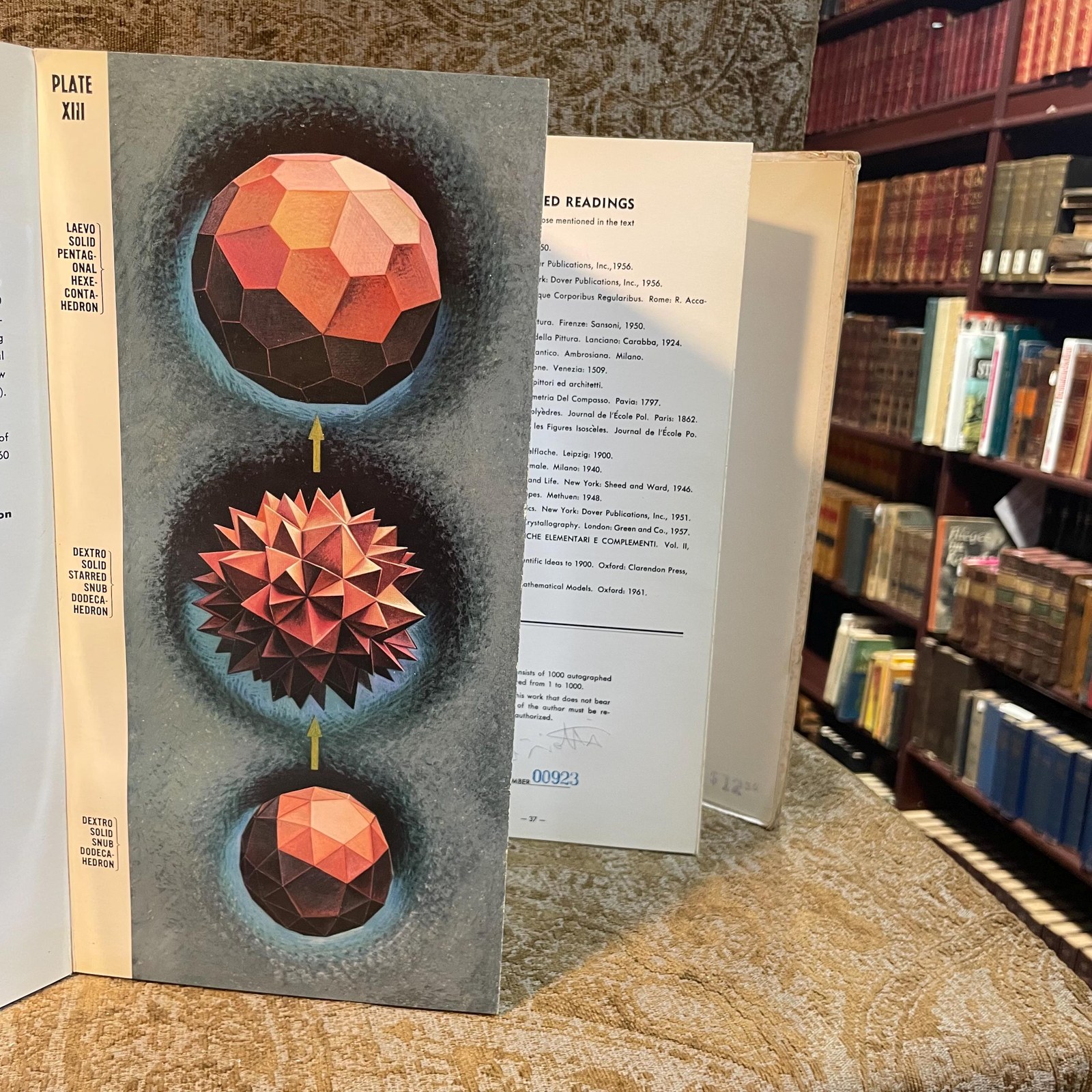
- Attestation page states " This Edition consists of 1000 Autographed copies numbered from 1 to 1000. Any copy of this work that does not beart the signature of the author must be regarded as unauthorized. (signed by author) Number 00923.
- Category
- Science & Medicine
- Record
- S.I.7370
Polyhedra. The Realm of Geometric Beauty
Author: Graziotti, Ugo Adriano (Carpenedolo, 7 May 1912 – Castenedolo, 18 November 2000)
4to. (5.5" x 11") 1962. Graziotti, Ugo Adriano. San Francisco. Ugo Adriano Graziotti. Limited Edition, author signed. Tall quarto with 38 glossy accordion folding pages. Printed upper board of polyhedra decoration with printed author/title, rear blank. Tan tape spine. Author autographed to attestation page, #00938/1000. Edgewear, corners bumped and rubbed with small loss to tips, head and foot of spine frayed with small loss, upper front hinge with 2" tear, covers lightly soiled (see pic). An interesting, scarce title for a mathematician, or anyone who likes shapes. Attestation page states " This Edition consists of 1000 Autographed copies numbered from 1 to 1000. Any copy of this work that does not beart the signature of the author must be regarded as unauthorized. (signed by author) Number 00923.
From Wiki: Ugo Adriano Graziotti (Carpenedolo, 7 May 1912 – Castenedolo, 18 November 2000) was an Italian sculptor, painter and mathematician. In America he won the Thiell Award for portrait in 1955, and the Anna Lee Stacey Award in Los Angeles in 1958. In January 1957, the San Francisco Art Commission accepted designs for a statue of Christopher Columbus to be erected in the small square of Coit Tower in North Beach. Among these projects were two particular drawings: one by Vittorio di Colbertaldo, from Verona, and the other by Adriano Graziotti, a local artist. The San Francisco Examiner of January 24, 1956 alludes to the fact that the Art Commission would reject Graziotti's 'bold' design in favor of a more conventional sculpture designed and executed by a person who was also a friend of the Consul General of Italy at the time—despite the fact that the local community was "strongly opposed" to the winning design. This model by Graziotti is entitled: The Genius of the Earth conqueror of space and was deposited in the Bancroft Library of the University of California - Berkeley on May 26, 1965. In 1966 the Pacific Science Center in Seattle commissioned him to do research on the partition of Euclidean space. The result was a series of publications - including An Historical Chart of Polyhedra in 1966. Upon his return to Italy in 1970 when he arrived in Rome, he decided to donate his models of balsa wood polyhedra to the Superintendence of Antiquities and Fine Arts of Rome. Now the 116 models are in the permanent collection of the Museum of Mathematics of the Municipality of Rome. These 116 models include the Platonic polyhedra and their duplicates (10), the Archimedean polyhedra and their duplicates (26), the Leonardo polyhedra (20) and their complementary star polyhedra (10), the starry polyhedra and their duplicates (22), the Graziotti polyhedra (3), the Archimedean prisms (10), the Archimedean antiprisms (5), the Starry Prisms and Antiprisms (10). Interestingly, the polyhedron groups mentioned above are further distinguished by color. Graziotti left 24 of these models in the natural color of balsa wood, and painted the remaining 92 models in ten different colors: yellow (31), red (20 - and exclusively for Leonardo's polyhedra--), green (15), gold (8), etc. This "classification" is intended to act as a subgroup, i.e. to arrange the models into mathematical classes and, at the same time, to serve as a historical referent. The photographs of these 116 balsa wood models have been published in a catalogue entitled: Polyhedra. The Polyhedra of the donation Adriano Graziotti, edited by Wilma di Palma, Àrgos Edizioni, Rome 1994, 144 pp. Shortly before his return to Italy, Graziotti designed and executed, in 1966, the illustration An Historical Chart of Polyhedra. Graziotti contributed to various drawings for a volume of anthropology entitled Atlas of primate gross anatomy: baboon, chimpanzee, and man, edited by the well-known anthropologist Daris Ray Swindler of the University of Washington. He also made anatomical drawings for the Primate Center of the Faculty of Medicine of the same university. A frequent visitor to the Seattle Zoo, he was fascinated by the famous gorilla Bobo to the point of making a sculpture of him. In Seattle, in addition to the various exhibitions he did, Graziotti continued his research and also held courses at Tacoma. At the same time he also continued his paintings, including Arpeggio, and Motion in color, The Poster to advertise the exhibition at the Frye Art Museum; among the sketches, The Concept of an Elephant Museum in Port Gamble, WA, and among the portraits, especially that of the young Doug Park and his sister. In 1970, shortly before his departure from Seattle to return to Italy, Graziotti created a painting called Totem. It is a very large painting, signed and dated, on the front and back, where the figure of a large salmon stands out. Graziotti's Totem is now owned by a private individual in Seattle.
Condition
Good
Guaranteed authentic and as described · 7-day returns · free US shipping — our terms. Subject to prior sale.