Home · Catalogue · Autographs & Manuscripts · S.I.3352
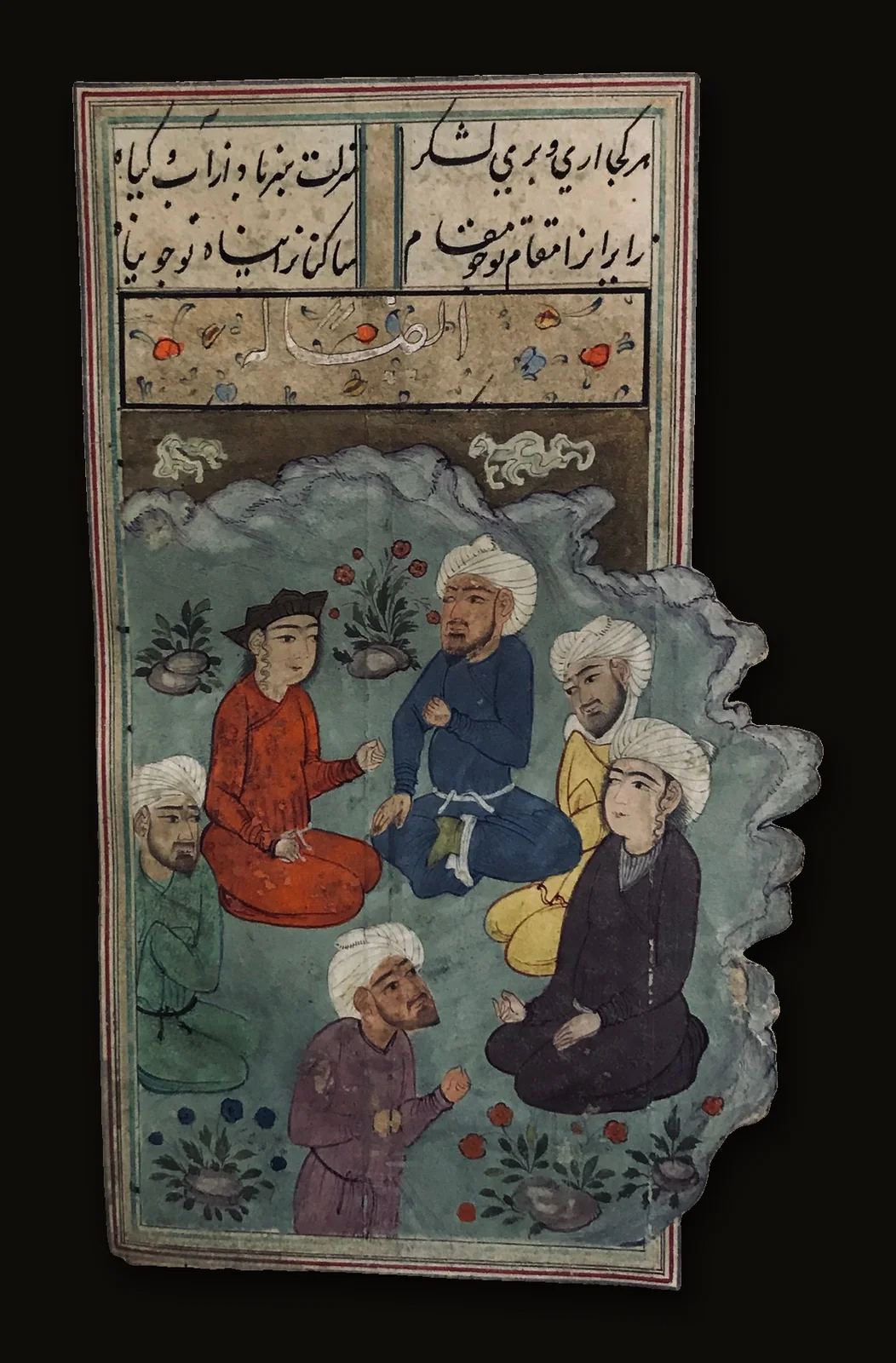
Manuscript of Persian Verse with 6 finely executed illuminated miniatures. Bookplate of American diplomat Lewis Einstein.
Abu Al-Faraj Rumi · Turkey or Persia
- Author
- Abu Al-Faraj Rumi
- Date
- n.d. c.1820
- Place
- Turkey or Persia
- Publisher
- zz
- Language
- English
- Binding
- Small 8vo. (6 x 4.25 inches). Bound in brown goatskin, boards stamped in gilt with mandorias and borders in blind. Rebacked in 20th century. One leaf with unsightly smudges and another with minor smudges in board, otherwise clean and fresh.
- Format
- Manuscript volume of Persian Verse with 6 finely executed illuminated miniatures. Manuscript on polished paper. Polychrome initial leaf in blue, red, black and gold with title panel in gilt, text in fine nastaliq hand, 12 lines in double columns with ruled color borders, floral sectional headings, 6 miniatures in text. 69 leaves. Incomplete. Bookplate of American diplomat Lewis Einstein. Wikipedia - Lewis Einstein Early life Einstein was born on March 15, 1877 in New York City. He was the only son of wool magnate David Lewis Einstein (1839–1909) and, his wife, Caroline (née Fatman) Einstein (1852–1910). Lewis had two sisters: Amy Einstein, who married Joel Elias Spingarn, and Florence Einstein, who married Sir Charles Waldstein. Among his family was uncle, Henry L. Einstein, the proprietor of The New York Press, and Judah P. Benjamin, a U.S. Senator from Louisiana who served as the Confederate States Attorney General, Secretary of War, and Secretary of State. Einstein graduated from Columbia University in 1898, and earned a master's degree in 1899. Career Einstein's diplomatic career began in 1903, when he was appointed as Third Secretary of Legation at Constantinople. Einstein advanced from Second Secretary to First Secretary and then Charge d'Affairs during the Young Turk Revolution of 1908, remaining in Constantinople despite the hostilities. For one month in 1911, he served as United States Ambassador to Costa Rica (having been appointed by President William H. Taft) before his wife's ill health in the country's high altitude forced him to leave the post. Books and writings In the winter 1912/13, he published anonymously the article "The Anglo-German Rivalry and the United States" in the British magazine The National Review, in which he warned of a coming war between Germany and Britain, claiming that "unperceived by many Americans, the European balance of power is a political necessity which can alone sanction on the Western Hemisphere the continuance of an economic development unhandicapped by the burden of extensive armaments" and that "if ever decisive results are about to be registered of a nature calculated to upset what has for centuries been the recognized political fabric of Europe, America can remain indifferent thereto only at its own eventual cost. If it then neglects to observe that the interests of the nations crushed are likewise its own, America will be guilty of political blindness which it will later rue." In November 1914, when the First World War was already raging, he published a second article "The War and American Policy" in the same publication. Both articles were in early 1918 reprinted as a book with a foreword by Theodore Roosevelt. He returned to Constantinople in 1915, and wrote his diaries which would be later published under the name Inside Constantinople: A Diplomatist's Diary During the Dardanelles. Einstein kept the diary from the months of April to September, covering the Entente's campaign to conquer the capital city of the Ottoman Empire starting with a landing on the northern shore of the Dardanelles, which went in the history as the defeat of the Gallipoli Campaign (Gelibolu in modern Turkish). Einstein also paid special attention to the massacres of Armenians and wrote about it extensively throughout the diary. He desccompartmented the events and stated that "the policy of murder then carried out was planned in the coldest blood" in the preface of his diary. Einstein blamed the cooperative pact between Germany and the Ottoman Empire as the supportive and responsible agents behind the massacres. He also pointed out that the stockpiles of armaments that was used as a justification for the arrests was in fact a "myth". By August 4, Einstein wrote in a diary entry that the "persecution of Armenians is assuming unprecedented proportions, and is carried out with nauseating thoroughness." He kept in contact with both Enver and Talat and tried to persuade them to reverse their policy towards the Armenians. In a diary entry, he states that Talat insisted that the Armenians sided with the enemies and that Enver believed the policy was out of military necessity, but in reality both leaders feared the Armenians. U.S. Minister to Czechoslovakia On October 8, 1921, Warren Harding appointed Einstein to replace Richard Crane as the United States Envoy Extraordinary and Minister Plenipotentiary to Czechoslovakia. He was recommended by Senators Wadsworth and William M. Calder. He presented his credentials on December 20, 1921 and held the position until he left his post on February 1, 1930. He was also a member of the Council on Foreign Relations.
- Category
- Autographs & Manuscripts
- Record
- S.I.3352
[Abu Al-Faraj Rumi] Manuscript volume of Persian Verse with 6 finely executed illuminated miniatures. Manuscript on polished paper. Polychrome initial leaf in blue, red, black and gold with title panel in gilt, text in fine nastaliq hand, 12 lines in double columns with ruled color boarders, floral sectional headings, 6 miniatures in text. 69 leaves. Incomplete. Small 8vo. (6 x 4.25 inches). From Turkey or Persia. No date, but determined to be early 19 century.
Bound in brown goatskin, boards stamped in gilt with mandorias and borders in blind. Re-backed in 20th century. One leaf with unsightly smudges and another with minor smudges in board, otherwise clean and fresh. Collector's stamp and note date 1299 A.H. (1882) C.E.). Bookplate of American diplomat Lewis Einstein. Good+.
Free worldwide shipping.
Wikipedia - Lewis Einstein Early life Einstein was born on March 15, 1877 in New York City. He was the only son of wool magnate David Lewis Einstein (1839–1909) and, his wife, Caroline (née Fatman) Einstein (1852–1910). Lewis had two sisters: Amy Einstein, who married Joel Elias Spingarn, and Florence Einstein, who married Sir Charles Waldstein.
Among his family was uncle, Henry L. Einstein, the proprietor of The New York Press, and Judah P. Benjamin, a U.S. Senator from Louisiana who served as the Confederate States Attorney General, Secretary of War, and Secretary of State.
Einstein graduated from Columbia University in 1898, and earned a master's degree in 1899.
Career Einstein's diplomatic career began in 1903, when he was appointed as Third Secretary of Legation at Constantinople. Einstein advanced from Second Secretary to First Secretary and then Charge d'Affairs during the Young Turk Revolution of 1908, remaining in Constantinople despite the hostilities.
For one month in 1911, he served as United States Ambassador to Costa Rica (having been appointed by President William H. Taft) before his wife's ill health in the country's high altitude forced him to leave the post.
Books and writings In the winter 1912/13, he published anonymously the article "The Anglo-German Rivalry and the United States" in the British magazine The National Review, in which he warned of a coming war between Germany and Britain, claiming that "unperceived by many Americans, the European balance of power is a political necessity which can alone sanction on the Western Hemisphere the continuance of an economic development unhandicapped by the burden of extensive armaments" and that "if ever decisive results are about to be registered of a nature calculated to upset what has for centuries been the recognized political fabric of Europe, America can remain indifferent thereto only at its own eventual cost. If it then neglects to observe that the interests of the nations crushed are likewise its own, America will be guilty of political blindness which it will later rue."
In November 1914, when the First World War was already raging, he published a second article "The War and American Policy" in the same publication. Both articles were in early 1918 reprinted as a book with a foreword by Theodore Roosevelt.
He returned to Constantinople in 1915, and wrote his diaries which would be later published under the name Inside Constantinople: A Diplomatist's Diary During the Dardanelles. Einstein kept the diary from the months of April to September, covering the Entente's campaign to conquer the capital city of the Ottoman Empire starting with a landing on the northern shore of the Dardanelles, which went in the history as the defeat of the Gallipoli Campaign (Gelibolu in modern Turkish).
Einstein also paid special attention to the massacres of Armenians and wrote about it extensively throughout the diary. He described the events and stated that "the policy of murder then carried out was planned in the coldest blood" in the preface of his diary. Einstein blamed the cooperative pact between Germany and the Ottoman Empire as the supportive and responsible agents behind the massacres.
He also pointed out that the stockpiles of armaments that was used as a justification for the arrests was in fact a "myth". By August 4, Einstein wrote in a diary entry that the "persecution of Armenians is assuming unprecedented proportions, and is carried out with nauseating thoroughness." He kept in contact with both Enver and Talat and tried to persuade them to reverse their policy towards the Armenians. In a diary entry, he states that Talat insisted that the Armenians sided with the enemies and that Enver believed the policy was out of military necessity, but in reality both leaders feared the Armenians.
U.S. Minister to Czechoslovakia On October 8, 1921, Warren Harding appointed Einstein to replace Richard Crane as the United States Envoy Extraordinary and Minister Plenipotentiary to Czechoslovakia. He was recommended by Senators Wadsworth and William M. Calder. He presented his credentials on December 20, 1921 and held the position until he left his post on February 1, 1930. He was also a member of the Council on Foreign Relations.
Condition
Condition report available on request — ask and we will send a written report with additional photographs.
Guaranteed authentic and as described · 7-day returns · free US shipping — our terms. Subject to prior sale.