Home · Catalogue · Philosophy & Classics · S.I.1810

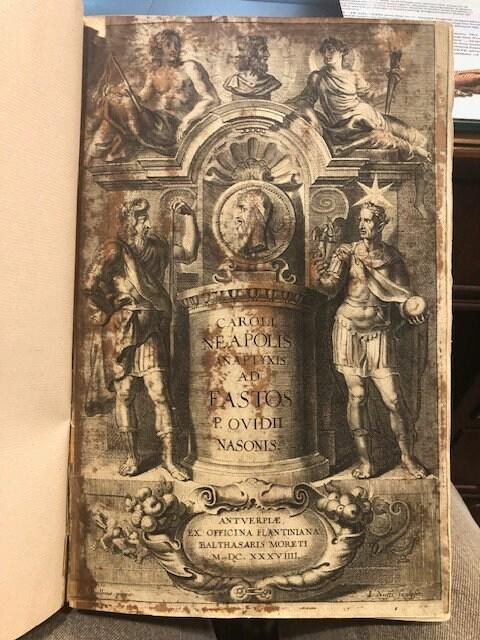

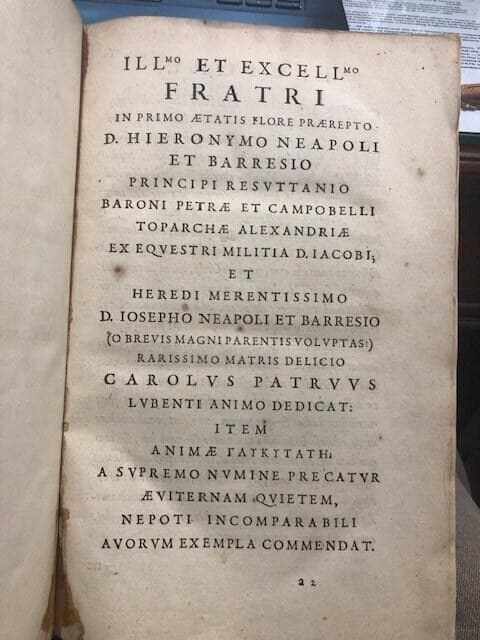
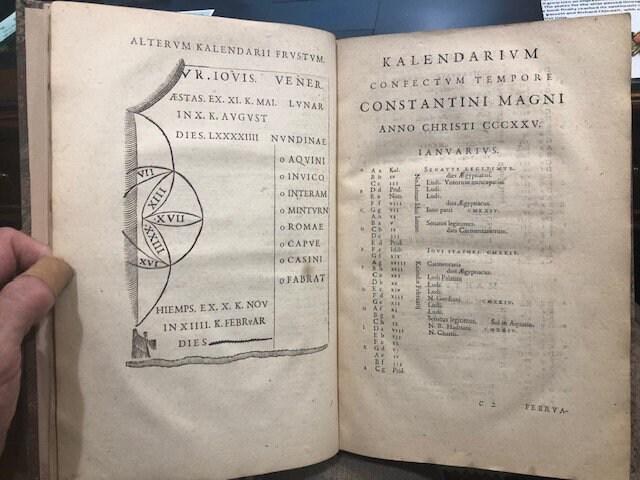
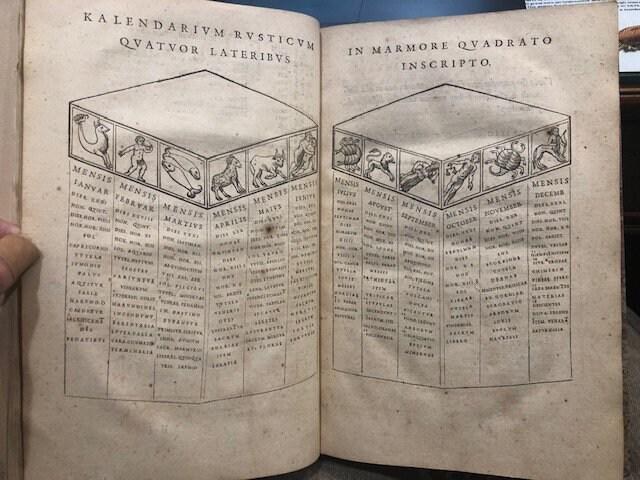
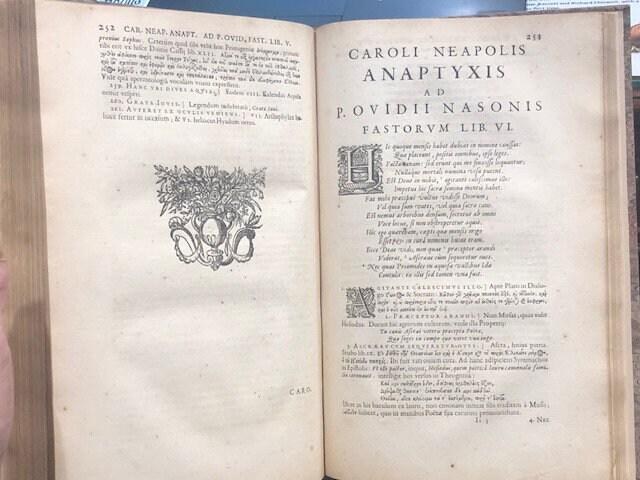
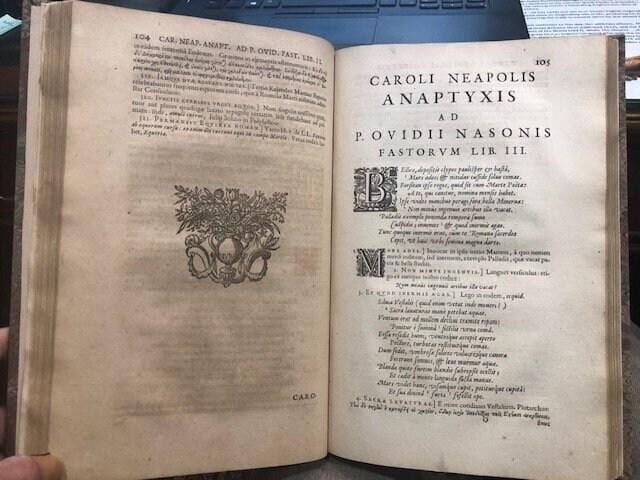
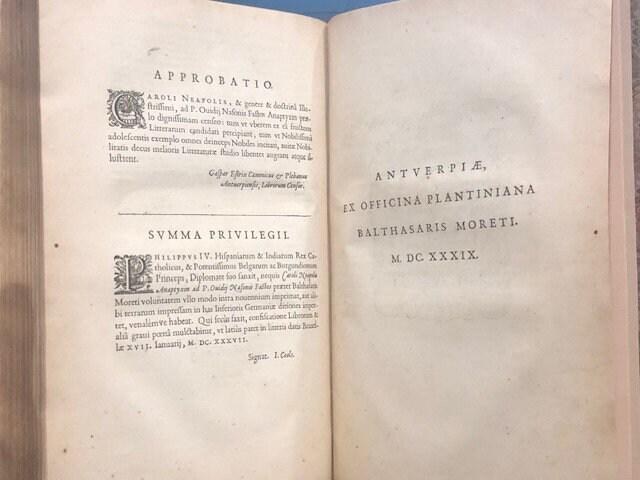
1639 Ovid's Writings on the Roman Holidays with engraved title page. Latin. The Book of Days. 6 books in 1 vol.
- Date
- 1639
- Category
- Philosophy & Classics
- Record
- S.I.1810
Caroli Neapolis Anaptyxis Fastos Ovidianos (Book of Days or On The Roman Holidays) Translated from Latin: Karolos Neapolis Development Fatios Ovidianos
Author: Carlo di Neapoli, Ovidius Naso, Publius
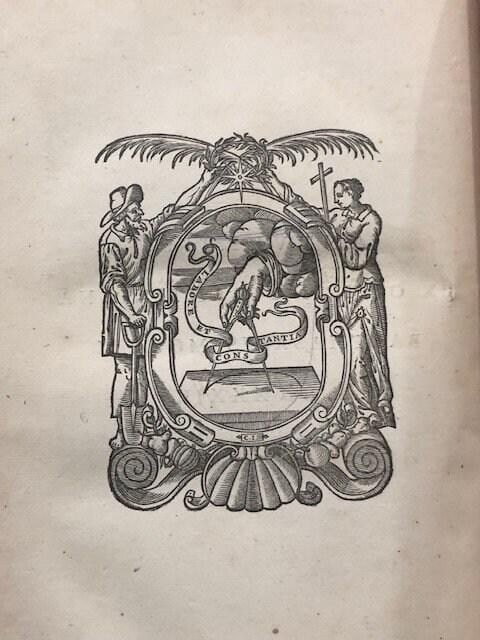
Folio (7.75" x 12.125") 1639. Carlo di Neapoli. Antverpiae: Officina Plantiniana Balthasaris Moreti. Modern rebound half calf with decorative blindstamp to leather edges over marbled boards. Spine with five gilt decorated raised bands, gilt title on gilt bordered brown leather to second compartment, single floral blindstamp design centered to all other compartments. Gilt date to foot. Beige endpapers, renewed. Professionally relined engraved title page. Large publisher's colophon to rear page. A beautiful 17th century book in a modern binding. The engraved title-page to Carlo di Neapoli's "Anaptyxis ad Fastos P. Ovidii Nasonis" (Antwerp: Balthasar Moretus) 1639; title written on a pedestal at centre, surmounted by a medallion with a bust of Ovid, and flanked by Julius Caesar and another ruler, a bust of Janus at top centre; after Erasmus Quellinus. 1639 Lettered within image, at center: "Caroli / Neapolis / Anaptyxis / ad / Fastos / P. Ovidii / Nasonis." and "Antverpiæ / ex Officina Plantiniana / Balthasaris Moreti / MDCXXXVIIII.". Signed within image, in lower corners: "E. Quellinus pinxit" and "I. Neeffs sculpsit." Translated from Latin: Charles / Neapolis / Anaptyxis / ad / Fastos / P. Ovid / Nasonis." and "Antwerp / ex Officina Plantiniana / Balthasar Moreti / MDCXXXVIII.". Signed within image, in lower corners: "E. Quellinus painted" and "I. Neeffs carved.
From Wiki: Publius Ovidius Naso (Latin: [ˈpuːbliʊs ɔˈwɪdiʊs ˈnaːso]; 20 March 43 BC – 17/18 AD), known in English as Ovid (/ˈɒvɪd/ OV-id), was a Roman poet who lived during the reign of Augustus. He was a younger contemporary of Virgil and Horace, with whom he is often ranked as one of the three canonical poets of Latin literature. The Imperial scholar Quintilian considered him the last of the Latin love elegists. Although Ovid enjoyed enormous popularity during his lifetime, the emperor Augustus exiled him to Tomis, the capital of the newly-organized province of Moesia, on the Black Sea, where he remained for the last nine or ten years of his life. Ovid himself attributed his banishment to a “poem and a mistake”, but his reluctance to disclose specifics has resulted in much speculation among scholars.
Today, Ovid is most famous for the Metamorphoses, a continuous mythological narrative in fifteen books written in dactylic hexameters. He is also known for works in elegiac couplets such as Ars Amatoria ("The Art of Love") and Fasti. His poetry was much imitated during Late Antiquity and the Middle Ages, and greatly influenced Western art and literature. The Metamorphoses remains one of the most important sources of classical mythology today.
The poem is an extensive treatment on the Roman calendar or fasti. Each of its separate books discusses one month of the Roman calendar, beginning with January. It contains some brief astronomical notes, but its more significant portions discuss the religious festivals of the Roman religion, the rites performed upon them, and their mythological explanations. These explanations preserve much mythological and religious lore that would have otherwise been lost.
January (Book 1) The first book opens with a prologue which contains a dedication (1–62) of the poem to Germanicus, Ovid's recusatio, and a description of the poem's theme as the Roman calendar, festivals, and annual astronomical events, followed by a discussion of Romulus' and Numa's invention of the Roman calendar. The first episode (63–294) is an interview between the poet and the god Janus about the details of his nature as primal creator (Chaos), history, iconography, and festival on the Kalends of January. The second long episode (317–456) describes the Agonalia, the aetiologies of sacrificial animals, the story of Aristaeus, and the story of Lotis and Priapus. The third episode (461–636) for the Carmentalia discusses the exile of Evander to Latium, the prophecy of his mother Carmentis about Aeneas, Augustus, and Livia, and the myth of Hercules and Cacus, ending with the praise of the family of Augustus. The end of the book talks about the festival of Concordia (637–650), the movable Sementivae with a prayer for agricultural productivity (655–704), and the feast of the Ara Pacis (709–724).
February (Book 2) Ovid opens book 2 with an etymological derivation of February from februa (instruments of purification) (1–54). He continues relating several shorter narratives, including the stories of Arion and the dolphin (79–118), Augustus' assumption of the title pater patriae (119-148), the myth of Callisto (153–192), the fall of the Fabii at the battle of the Cremera (193–242), and the fable of the constellations of the Raven, Snake, and Crater (243–266). The next long section in the book discusses the festival of the Lupercalia (267–474). The poet aetiologizes the nakedness of the Luperci with a story of Faunus' sexual humiliation when he tries to rape Hercules dressed as Omphale and the story of Remus' defeat of cattle rustlers. The narrative of the she-wolf suckling Romulus and Remus is also included. Lines 475–532 describe Romulus' transformation into Quirinus, which is followed by the narrative of Lara in connection to the Feralia (533–616). The final extensive section describing the Regifugium describes the legends associated with the fall of the Tarquins, Lucretia's rape and suicide, and Brutus' revenge (685–855).
March (Book 3) The third book is dedicated by Ovid to Mars, the patron of the month; in connection to the god, the poet narrates the rape of Silvia, the birth and discovery of Romulus and Remus, and ends with a discussion of March as the former first month of the year (1–166). Next, the poet interviews Mars who tells the story of the rape of the Sabine women to explain why women worship him, and of Numa's capture of Jupiter and the gift of the ritual shields, the ancilia and the introduction of the salii (167–398). Next Ovid relates two short narratives, the story of Romulus' asylum and the temple of Jupiter Veiovis (429–458) and Ariadne's complaint of unfaithfulness to Bacchus and subsequent katasterism of Ariadne's crown (459–516). A long section describes the feast of Anna Perenna on the Ides, focusing on the story of the Vergilian Anna's escape from Carthage and journey to Italy where she becomes the river Numicius, the legend of Anna's deceit of Mars when he attempted to woo Minerva, and ending with a note on the murder of Caesar (523–710). The end of the month includes the legends of Bacchus' discovery of honey for the Liberalia (713–808), a prayer to Minerva for the Quinquatrus (809–848), and the story of Phrixus and Helle for the Tubilustrium (849–878).
April (Book 4) April begins with the appearance of Venus, who chides Ovid for his abandonment of erotic elegy; Ovid goes on to trace the genealogy of the Roman kings and Augustus from Venus and ends with a celebration of Venus as the goddess of creation (1–132). The first long episode of the book is the festival of the Magna Mater, the Ludi Megalenses. For this festival Ovid recounts the birth of Rhea's children, the castration of Attis, the goddess' transfer to Rome, and the story of Claudia Quinta (179–375). The next narrative, which is the longest and most elaborate in the Fasti describes the Cerialia and the rape of Persephone, the wandering of Ceres, and the return of Persephone to Olympus (393–620). The next extended section is regarding the festival of the Parilia which includes agricultural prayers, aetiologies of customs, and the story of the founding augury and death of Remus (721–862). The final sections tell the story of Mezentius in connection to the Vinalia (863–900) and include an agricultural prayer on the Robigalia (901–942).
May (Book 5) This book opens with the presentation by the Muses of three etymologies for the name of the month: the goddess Maiestas, the Roman elders (maiores), and Maia the mother of Mercury (1–110). Ovid is unable to decide on a correct etymology. In the next section the goddess Flora appears and discusses her origin, her help in Juno's conceiving of a child, and the political origin of her games (159–378). The next notable narrative discusses the rituals of the Lemuria and the funeral of Remus (419–490). The birth of Orion from the urine (ouron) of the gods comes next (493–544). This is followed by the origin of the Temple of Mars Ultor (545–598), the end of human sacrifice at Rome (603–662), the worship of Mercury (663–692), and the death of Castor and Pollux (693–720).
June (Book 6) The sixth book begins with a prologue in which the goddesses Juno and Juventas (Hebe) dispute over which goddess the month is named after (1–100). Ovid goes on to relate the story of the affair of Carna, the goddess of hinges, and Janus as well as the story of how Proca was defended from murderous owls by Cranae (101–195). The next large narrative is the discussion of iconography and aetiology of the Vestalia, the festival of Vesta. The cosmic identification of Vesta with the earth, the story of Priapus' attempted rape, the origin of the altar of Jupiter Pistoris (of the bakers) in the Gallic invasion of Rome, and the rescue of the Palladium by Metellus in a fire at the temple are recounted (249–468). A short astronomical notice precedes the long discussion of the Matralia in which Ovid explains the origin of the cult of Mater Matuta who as Ino journeyed to Italy and was made a goddess (473–569). This is followed by the story of the murder of King Servius Tullius, a lover of Mater Matuta. The Lesser Quinquatrus' legend follows about the exile and return of Roman flute players (649–710). The final notable episodes of the poem are the punishment of Aesculapius (733–762) and the praise of Marcia by Clio (797–812).
Missing books Though Ovid mentions he had written twelve books, no verified ancient text has been discovered with even a quotation from the alleged books for July through December (books 7 to 12).[10] In 1504 the eccentric humanist and classical text collector Conrad Celtes claimed to have discovered the missing books in a German monastery. He wrote a letter about the books to the Venetian publisher Aldus Manutius, who insisted on seeing them himself before signing a contract.[11] The purported missing verses had actually been composed by an 11th-century monk, were known to the Empire of Nicaea and had allegedly informed a popular harvest festival under the reign of John III Doukas Vatatzes, but even so, many contemporaries of Celtes believed him, and classical scholars continued to write about the existence of the missing books until well into the 17th century.[12]
Free shipping via USPS for United State purchaser within the continental U.S., International shipping determined using USPS Priority Express, DHL, FedEx, or Parcel Monkey,
Sonny Ideker Bookseller is located within City Antiques in Historic Roswell, Georgia at 700 Holcomb Bridge Road, Roswell, GA. 30076. We would love to have you visit, or email us at sidekerbookseller@gmail.com for specific wants or needs, thanks!
Antique Books, Old Leather Book, Old Vellum Book, Decorative Binding, Antiquarian Book, Vintage decorative, Ancient Leather, Rare Books, Ancient Greek Writer, 17th century, Ovid
Half brown leather, Marbled Boards, Modern Binding, Engraved Title Page, Ancient Greek, 6 vol in 1, Decorative Books, Decorative Leather, Beautiful Decorative Book
Condition
Condition report available on request — ask and we will send a written report with additional photographs.
Guaranteed authentic and as described · 7-day returns · free US shipping — our terms. Subject to prior sale.